Backup Schedule Strategy and Best Practices
A backup schedule defines how often copies are created and when backup tasks run. A good schedule should create recovery points often enough to protect important changes without overloading storage, networks, or production systems.
The best backup schedule depends on how quickly data changes, how much recent work can be lost, how long backups take, and how many previous versions need to remain available. For this reason, backup frequency for an active database may be very different from the schedule used for archives, photos, or rarely changed project files.

Start with Recovery Needs, Not the Calendar
A common mistake is choosing “daily” or “weekly” simply because it sounds convenient. A more useful starting point is deciding how much new data you could realistically afford to lose after a failure.
If losing one working day would cause serious problems, a weekly backup schedule is clearly too infrequent. If losing several hours would be unacceptable, scheduled backups may need to run several times per day.

Use Data Change Rate to Set Backup Frequency
Backup frequency should normally follow the rate at which useful information changes. A database updated continuously may require frequent recovery points, while an archive that changes once a month may not need daily protection.
This approach keeps the schedule practical: frequently changing data gets more protection, while stable data does not generate unnecessary backup traffic or storage usage.

Match the Schedule to the Backup Method
Frequency alone does not define a backup strategy. Full, incremental, and differential methods behave differently and should be scheduled accordingly. If you are deciding which method fits a particular workload, the guide to different backup types and their use cases explains how full, incremental, differential, and other approaches affect storage and recovery.
Backup Schedule Examples by Data Type
The following examples show why the same scheduled backup frequency does not work equally well for every workload.
| Data | Typical Change Rate | Example Backup Schedule | Reason |
|---|---|---|---|
| Active database | Continuous | Every few hours | Reduces the amount of recent transactional data outside the latest recovery point. |
| Business documents | Daily | Daily incremental + weekly full | Provides regular recovery points without repeating a full copy every day. |
| Project folders | Several times per week | Weekdays or every 1-2 days | Keeps recent project changes available without excessive backup activity. |
| Photo archive | Occasional | Weekly | Suitable when large collections change less frequently. |
| Long-term archive | Rare | Monthly | Creates historical recovery points without unnecessary daily copies. |
Example: If a company changes accounting files every business day, a Sunday-only backup could leave nearly a full week of work outside the latest copy. A daily schedule or a weekly full backup combined with smaller backups during the week provides much better recovery coverage.
Daily, Weekly, and Monthly Backup Roles

Daily Backup
Daily backups are suitable for information that changes during normal work. They are commonly used for documents, project folders, application data, and other files where losing several days of changes would be unacceptable.

Weekly Backup
A weekly backup works well for more stable data or as the full-backup layer in a mixed strategy. A common example is one full backup on the weekend with incremental or differential backups between full cycles.

Monthly Backup
Monthly backups are better suited to archives, historical recovery points, and long-term retention. They are normally an additional layer rather than the only backup frequency used for active business data.
A Practical Weekly Backup Strategy
The phrase weekly backup can describe two very different strategies. One system may create only one backup every week, while another may create a full backup weekly and additional scheduled backups every day.
For active data, the second approach usually provides much more useful recovery coverage. A weekly full backup can act as the baseline, while smaller backups capture changes made during the working week.
If you need a structured rotation with daily, weekly, and monthly recovery points, a Grandfather-Father-Son backup strategy provides a well-known example of how several backup frequencies can work together.
Example weekly cycle
Sunday: Full backup
Monday: Incremental backup
Tuesday: Incremental backup
Wednesday: Incremental backup
Thursday: Incremental backup
Friday: Incremental backup
Saturday: Incremental backup
Why this works: the full backup starts a new weekly chain, while scheduled incremental backups create daily recovery points with much smaller data transfers.
Three Backup Schedules for Different Situations
Home PC
Goal: protect documents, photos, and personal files without running large backup jobs every day.
Schedule:
Sunday: full backup
Monday-Saturday: incremental backup
This provides daily recovery points while keeping routine backup jobs relatively small.
Small Business
Goal: protect office files daily while giving critical data shorter recovery intervals.
Schedule:
Full backup once per week
Incremental backup every night
Critical folders every 4 hours
Separate scheduled backup tasks allow different data sets to use different frequencies.
Archive Storage
Goal: preserve historical information that rarely changes.
Schedule:
Monthly full backup
Longer retention for selected monthly copies
Daily backups would provide little additional value when the source itself changes infrequently.
Backup Schedule Best Practices
1. Avoid Giving Every Task the Same Frequency
A server database, an employee document folder, and a static archive usually do not need identical backup intervals. Use separate scheduled backup tasks when different data sets have different recovery requirements.
2. Keep Full Backups at Practical Intervals
Full backups simplify recovery but process more data. Instead of creating a full copy every day, many schedules use periodic full backups with incremental or differential backups in between.
3. Do Not Let Backup Jobs Compete for the Same Resources
If several large backup tasks start at exactly the same time, they may compete for disk I/O, network bandwidth, or access to remote storage. Distributing backup windows can reduce this contention.
4. Include Retention in the Schedule Design
A backup schedule creates recovery points, but retention determines whether those recovery points still exist when they are needed. A daily backup kept for only two days serves a different purpose from a daily backup retained for several weeks.
5. Review the Schedule After Workloads Change
Backup scheduling best practices are not static. A folder that once changed weekly may later become an active project repository, while a database may grow enough that its backup window needs to be adjusted.

Backup Rotation and Schedule Are Not the Same Thing
A backup schedule answers when a backup runs. A rotation scheme also defines how backup sets are replaced, reused, or retained over time.
For environments that need a more formal cycle of recovery points, the guide to backup rotation schedules explains how recurring backup sets can be organized over daily, weekly, and longer retention periods.
Schedule
Defines task timing and frequency: for example, every day at 10 PM, every Friday, or every four hours.

Rotation
Defines how recovery points are grouped, retained, replaced, or moved through a longer backup cycle.
How Storage Changes Backup Scheduling

The destination can affect the best time for a scheduled backup. A local disk may handle frequent small tasks easily, while cloud or remote storage depends on network availability and bandwidth.
Large transfers may be better scheduled outside busy hours, while smaller incremental backups can often run more frequently. NAS, SFTP, cloud storage, and remote servers may also require different retry or missed-task behavior if a connection is temporarily unavailable.
From Backup Strategy to Scheduled Backup Software
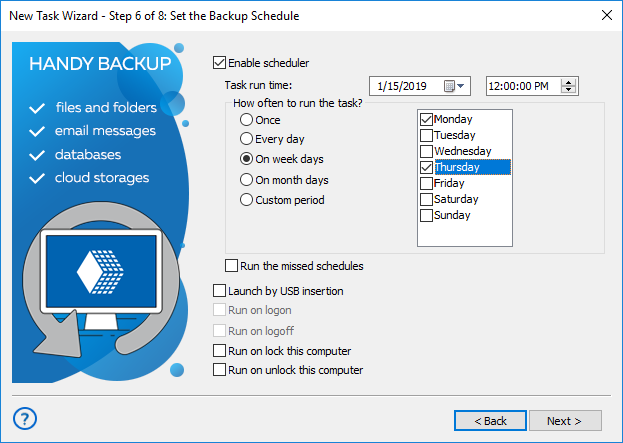
Once the required backup frequency is known, automation removes the need to start each task manually. Automatic backup software can execute recurring tasks according to daily, weekly, monthly, or custom intervals while applying the backup method and storage settings defined for each task.
Handy Backup can create separate schedules for different sources, so a database, project folder, and archive do not have to follow the same backup routine.
Tasks can also use full, incremental, or differential backup methods, compression, encryption, versioning, notifications, and different storage destinations depending on the required backup strategy.
Choosing the Best Backup Schedule
The best backup schedule is the one that creates useful recovery points before the amount of unprotected new data becomes unacceptable.
Start by identifying how often each data source changes. Then decide how much recent information can be lost, choose an appropriate backup type, determine how long recovery points should remain available, and select a storage destination capable of supporting that frequency.
For many environments, this results in several schedules rather than one universal rule: frequent backups for critical data, daily backups for active files, weekly full backups for a new baseline, and monthly copies for longer-term recovery.
Scheduling Backup to Online Storage
Some storage options may impose additional requirements that can restrict backup scheduling. This is particularly evident with online storage, where a stable network connection is crucial during scheduled backup tasks. Even common tasks like scheduling backups to NAS in local networks rely heavily on connection reliability.
How to Organize Cloud Backup Scheduling
When scheduling cloud backup tasks (e.g., if you schedule backup to OneDrive or Google Drive), an additional consideration is the technical availability of the data exchange interface, which may be temporarily disrupted by a firewall or maintenance job. Implementing an option to run missed tasks can help mitigate this issue!
 Download for Free
Version 8.7.3, built on August 11, 2026. 152 MB
30-day full-featured trial period
Automate your backup tasks and ensure the regular and efficient saving of all your data! Get a copy of Handy Backup now with a free 30-day trial and start implementing backup schedule best practices!
See Also: